


1351 stories
·
0 followers

Make Visual Studio look the way you want

2 Shares

Themes are personal. Some of us live in dark mode, some swear by high contrast, and some of us have very strong opinions about that one shade of blue from years ago. The new themes in Visual Studio 2026 are built on Fluent, which gives us a much more consistent and accessible foundation, but we have heard from plenty of you who want more control over specific colors. Accent colors, hover states, the line between the shell and the tab headers… the small things that make an IDE feel like yours.

So, we did something about it.

theme color settings image

Visual Studio now has a new Theme colors options page that lets you customize any Fluent color token directly inside the IDE. No extensions, no JSON files to hunt down, no restarts. Just open the page, find the token you want, and pick a new color.

Where to find it

Open it from Tools > Options > Environment > Visual Experience > Theme colors. You’ll see every Fluent color token in the active theme listed in a searchable grid. Pick one, change the color, and the change applies live.

Customizations are per-theme

This is the part we like the most. Whatever you change is saved against the current theme, not globally. So, you can have your own personal twist on Dark, a different twist on Light, and a wildly different one on a tinted theme, and switching between them brings your customizations along automatically.

If you go too far down a rabbit hole, there’s a per-color reset so you can revert a single token without throwing away the rest of your work.

New tokens for more granular control

Alongside the options page, we also added some new color tokens that give you more separation between parts of the shell. The most commonly asked-for one is being able to color the tab and window headers independently from the rest of the shell chrome, which, among other things, lets you get pretty close to a classic retro look if that’s what you’re after.

See all the color tokens in the theme color tokens documentation.

fluent blue theme image

Sharing your customizations

Because customizations are saved as JSON under the hood, they’re easy to share – and easy to apply on top of any theme. Drop a JSON file into:

%LOCALAPPDATA%\Microsoft\VisualStudio\18.0_xxxxxxxx\ColorThemes

…and Visual Studio will use it to override the theme it’s named after. The file name has to match the theme you want to override – so cool-breeze.json overrides Cool Breeze, dark.json overrides Dark, and so on. Restart Visual Studio and the overrides take effect on top of that theme.

Here’s an example set of overrides that leans Cool Breeze in a more retro, blue direction. Save it as cool-breeze.json in the folder above:

[
  {
    "Name": "EnvironmentHeader",
    "Category": "5af241b7-5627-4d12-bfb1-2b67d11127d7",
    "Background": "FFF5CC84"
  },
  {
    "Name": "EnvironmentTab",
    "Category": "5af241b7-5627-4d12-bfb1-2b67d11127d7",
    "Background": "FFF5CC84"
  },
  {
    "Name": "EnvironmentBody",
    "Category": "5af241b7-5627-4d12-bfb1-2b67d11127d7",
    "Background": "FF5D6B99"
  },
  {
    "Name": "EnvironmentBodyText",
    "Category": "5af241b7-5627-4d12-bfb1-2b67d11127d7",
    "Background": "E4FFFFFF"
  },
  {
    "Name": "EnvironmentBackground",
    "Category": "5af241b7-5627-4d12-bfb1-2b67d11127d7",
    "Background": "FFCCD5F0"
  },
  {
    "Name": "EnvironmentHeaderInactive",
    "Category": "5af241b7-5627-4d12-bfb1-2b67d11127d7",
    "Background": "FFCCD5F0"
  },
  {
    "Name": "EnvironmentTabInactive",
    "Category": "5af241b7-5627-4d12-bfb1-2b67d11127d7",
    "Background": "FFCCD5F0"
  },
  {
    "Name": "StatusBarBackgroundFillRest",
    "Category": "5af241b7-5627-4d12-bfb1-2b67d11127d7",
    "Background": "FF40508D"
  }
]

Share that file with a teammate, and they’ll see the same look the next time they launch Visual Studio – no extension to install, no theme to package up.

You can also grab the Blue Steel theme pack that ships with these new colors to mimic the retro blue theme.

Why this matters

Themes used to be an all-or-nothing thing. If you didn’t love one of the built-in options, your only real path was an extension that replaced the entire theme. That’s a lot of overhead for what is often a very small change (“I just want this one color to be a little less bright.”).

The new options page is meant to fix exactly that. Quick, one-off customizations should feel quick. Bigger overhauls still belong in extensions, and the marketplace is full of great ones, but most of the feedback we get is about a handful of specific tokens. Now you can fix those in about ten seconds.

Availability

This is now in latest version of Visual Studio 2026 (18.7). Give it a try, break things in interesting ways, and let us know in the comments what tokens you ended up changing – we’re always curious how people set up their IDEs.

Happy coding!


The post Make Visual Studio look the way you want appeared first on Visual Studio Blog.

Read the whole story
Share this story
Delete

Are Many College Students Losing the Ability to Read?

2 Shares
Futurism reports: in a new essay for The Chronicle Higher Education, university-level literature and writing instructor Tyler Jagt recalls how not a single one of his students could get through an assigned 20-page article, something that he had read "without complaint" as an undergraduate a decade ago. One student confessed that the reason they didn't finish was that they kept losing track of what the paper was about. And there's no doubt that they're not alone. Jagt cites the 2024 National Assessment of Educational Progress reading assessment results released last year. It showed that 12th grade reading scores were at the lowest level since the assessment began in 1992. Nearly a third of those 12th graders scored below the assessment's "basic" level in reading, meaning they likely "cannot draw general conclusions based on concepts presented explicitly in a text." Younger children aren't better off: a recent report from the Annie E. Casey Foundation found that 70 percent of fourth graders, or around two million kids, can't read at a proficient level. "What I am seeing in my classroom is no longer a hunch," Jagt writes. "There is a measurable, generational collapse in sustained reading and writing, and the academy is responding to it with improvisation and exhaustion rather than the structural overhaul it requires...." Jagt cites an MIT study that found users who used ChatGPT during cognitive tasks like writing essays showed lower brain activity in areas associated with creativity compared to students who only used a traditional Google Search or didn't lookup information at all. An astonishing 83 percent of the AI users couldn't quote a single line from the essays they had just written, and capstoning the alarm, the brain activity in the AI users didn't return to normal when they were later asked to write without AI... On our pernicious pocket devices, Jagt touted a 2017 study that found that simply having a smartphone physically nearby — even if it's face down or turned off — reduced available cognitive capacity and impaired cognitive functioning. "So when a student tells me they 'kept losing track' of a 20-page article, I have to acknowledge that they may be describing a measurable neurological condition," Jagt wrote. "The neural pathways that support sustained attention are built by use, and they atrophy without it. Your body is a use-it-or-lose-it system, and the brain is no exception." Sunday an "Ask Reddit" question went viral — drawing over 11,000 upvotes — for its question to any teachers reading Reddit. "Is the 'Gen Alpha can't read (write, or do math ext)' crisis real? If so how bad is it?" Some responses... "The run of the mill non-honors kids have gotten really bad," posted one high school teacher. "Very low tolerance for working hard, very short attention span, very short stamina for active listening... It's the group that is the most worrying because a decade ago, I'd estimate that maybe 10-20% of kids at a school are like this, and now it's probably 40-50% of each graduating class... Then there's of course the bottom 10-20% kids (excluding the special ed/severe/moderate learning disability kids). This is what the viral videos are about and it's not an exaggeration. They can't read, write, or do very basic math like multiplication or division as a 17 year old." "This is the first year the MAJORITY of my class cheated on their first essays...." posted one high school English teacher. "It was also the first year a kid yelled 'We don't care about your fucking books, Miss!' while I was in front of the class presenting books they might be interested in for their book reviews... Almost all of them cheated on the book review they had to write." Thanks to long-time Slashdot reader schwit1 for sharing the article.

Read more of this story at Slashdot.

Read the whole story
Share this story
Delete

IT Workers Are Now Struggling to Find Work, as 'Picky' Companies Demand AI Skills

2 Shares
"Battered by years of mass layoffs, California tech workers were hoping the job market would rebound this year," reports the Los Angeles Times. "But things are getting worse." The class divide is widening in Silicon Valley as a tiny group of employees is landing unprecedented packages for AI skills, while many others struggle to find work. The have-nots are doing everything that used to guarantee great jobs — refreshing resumes, optimizing LinkedIn profiles and doing interviews — but companies are much more picky these days. The tech jobless are rethinking their lives. Some are taking pay cuts, others are leaving tech. Some are going back to study or launch startups. Some have retired.... Since 2022, more than 815,500 tech workers have been laid off, according to Layoffs.fyi, a website that tracks job cuts. The tsunami of pink slips surged in 2023, when companies that had gone on hiring sprees during the COVID-19 pandemic began to cut back. From January to April, U.S. tech employers announced 85,411 job cuts this year, up 33% from the same period last year, according to global outplacement and executive coaching firm Challenger, Gray & Christmas. The Public Policy Institute of California estimates that the number of information jobs — which includes jobs in hard-hit Hollywood as well as tech — tumbled 17% between the middle of 2022 and this February. The San Francisco Bay Area has been hardest hit, the institute said in a recent report, with the number of jobs declining by 0.4%, compared with 7.5% growth over a similar time span before COVID-19 slammed into the U.S. economy. Tech layoffs are also spilling over into other industries. Automaker General Motors laid off roughly 600 workers in its information technology department, and Walmart is reportedly laying off or relocating roughly 1,000 workers in its technology and products teams. Recruiters say companies have become much more selective, requiring AI skills, combining different positions and interviewing more people for each job. "You're seeing elongated hiring cycles," said Robert Lucido, senior director of strategic advisory at Magnit, a California company that helps tech giants and other businesses manage contractors, freelancers and other contingent workers. "There's more opportunity to fill the need that they truly want." Paul Flaharty, district president at staffing firm Robert Half in Los Angeles, said companies are laying off workers, but also creating new roles tied to AI initiatives. "For individuals that are displaced, it's really important that they find ways to upskill themselves so that they can make themselves as attractive as possible for these new jobs that are being created," he said. Kira Martins was already taking on more work in a small team at Snap — the parent company of disappearing messaging app Snapchat — when she was laid off in April. The company said the layoffs were to cut costs as it focuses on profitability, noting how employees are using AI to "reduce repetitive work, increase velocity, and better support our community, partners, and advertisers...." Martins, a 36-year-old Los Angeles resident, views AI as a tool and is optimistic about finding her next role. People still need to decide how to use AI and check the work it generates, she said. "In tech, you want to be a first adopter, because if you don't move quickly, it's very easy to become irrelevant," she said. "Everyone's kind of hopping on the AI train." A former Google worker (laid off more than a year ago) says he's still job hunting, according to the article, and "he's learned it's not enough to just apply in this competitive market. Workers really need to network and leverage their connections to get seen by hiring managers and stand out." But when 64-year-old product manager Bruce Bowers lost his job at Oracle — along with thousands of others — he just started his retirement early.

Read more of this story at Slashdot.

Read the whole story
Share this story
Delete

Workers Spend As Much Time 'Botsitting' AI As Producing Useful Work, Survey Finds

1 Share
"As the use of artificial intelligence spreads across companies worldwide, it is relieving workers of tedious old chores but creating new ones," reports the Los Angeles Times. "Most people don't realize the amount of time that they're spending working on the tools to get the time savings that they're professing," said Paul Leonardi, Duca Family professor of technology management at UC Santa Barbara." Leonardi is one of the co-authors of the new study published by the Work AI Institute, whose contributors include academics from Stanford University and UC Berkeley. The institute is sponsored by AI company Glean... The research surveyed 6,000 digital workers across the United States, the United Kingdom, and Australia between December and January. The report found that we are in a phase of significant personal productivity gains, but few companies are translating these gains into revenue and business growth. While 75% of individuals reported a boost in productivity, only 13% of the organizations say they have seen significant business gains as a result of AI adoption, the survey found... The reason the boost in productivity sometimes leads to waste, Leonardi said, is the time people spend correcting the bot's work and gathering the right files, documentation, and tacit knowledge required for it to produce high-quality output. "It's pretty striking the amount of time and effort people are spending," Leonardi said. Most employees now spend over six hours a week of their workday babysitting their work chatbots, the survey said. There is a "thick, mostly invisible layer of human labor holding the whole thing together," the report said. The survey found that for every hour a worker spends getting useful output from AI, they spend roughly another hour making it usable. Of the total time workers spend interacting with AI each week, 37% goes to botsitting, 36% to actually using the tool to produce work. Part of the reason so much time disappears into botsitting is how often the tools fall short: Workers report that more than a third of AI sessions fail outright, requiring a full restart or substantial rework. Paradoxically, as more workers hand over bigger parts of their jobs to AI, they are offloading personal judgment and responsibilities to the bots. The survey found 41% of workers say they sometimes deliver AI-generated work they couldn't explain if asked... "I think what's happening with a lot of these Gen AI tools right now is we're essentially expecting individual contributors to act as managers," Leonardi said. "They're just managing these AI tools, AI agents, and we're expecting that they'll be able to produce way more, but we're not taking into account all of the work that actually goes into managing." This problem isn't likely to go away.

Read more of this story at Slashdot.

Read the whole story
Share this story
Delete

Do trans people have Second Amendment rights? Wyoming says maybe not.

1 Comment and 3 Shares

Skip to the content

Jurisprudence
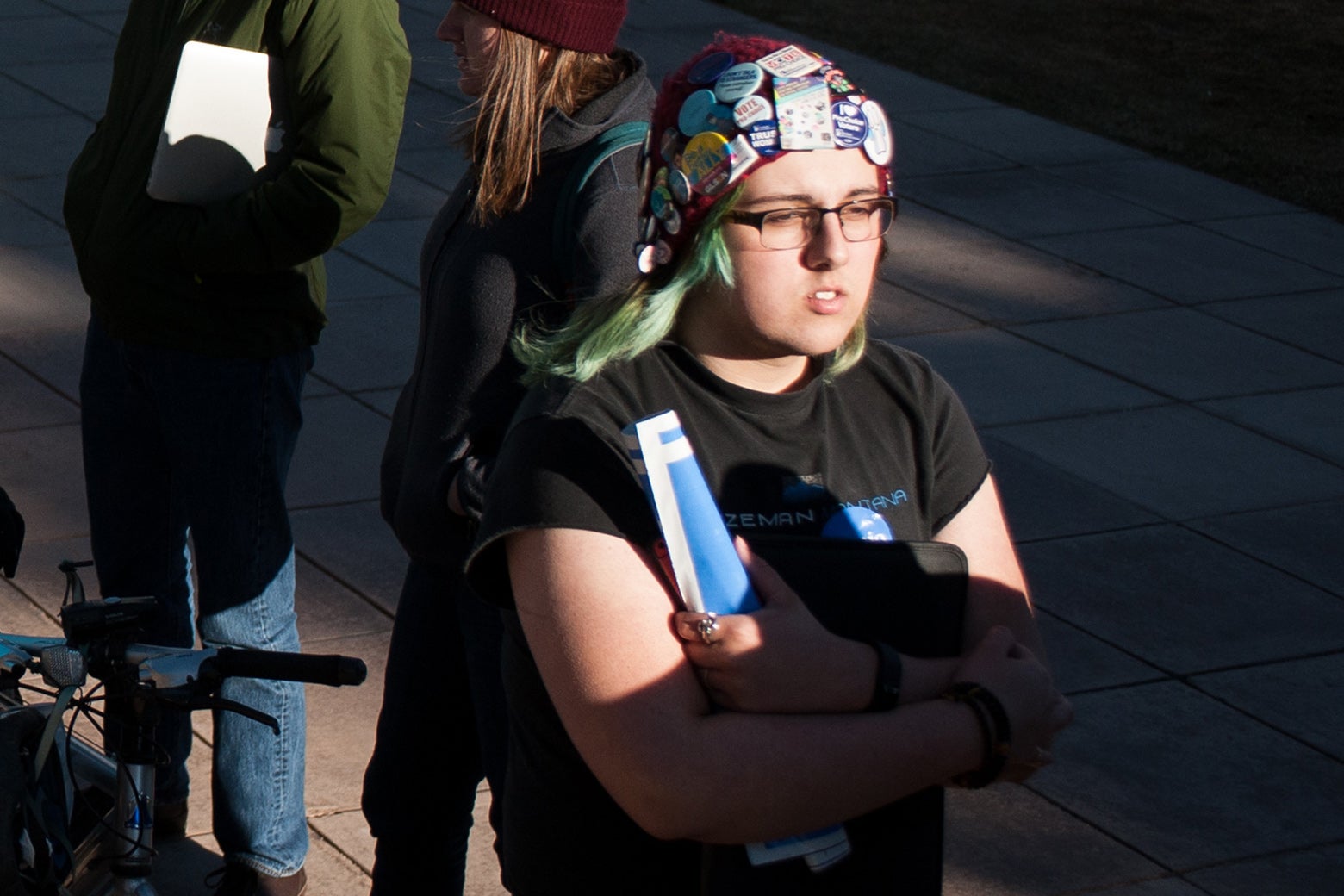
A young person with green-streaked hair, glasses, and a black t-shirt stands outside on a paved walkway while holding rolled-up papers and a tablet tightly to their chest. They are wearing a dark knit beanie covered in numerous political and social activism buttons, while other partially visible pedestrians and a bicycle stand in the background.

Last September, Ríhanna Kelver was standing outside the Crowbar & Grill in Laramie, Wyoming, preparing to start her bartending shift, when she noticed a group of men across the street. One of them was shouting in her direction, and Kelver heard several homophobic and transphobic slurs as he began approaching her. Moments later, according to court testimony and surveillance footage, the man shoved Kelver to the ground hard enough to injure her tailbone.

Kelver responded by drawing a pistol from her bag, chambering a round, and pointing the weapon at the man who had pushed her. She kept the safety on and never fired. The man and his companions retreated.

Today, Kelver, a 28-year-old trans woman, faces two felony charges—aggravated assault and possession of a deadly weapon with unlawful intent—that could carry up to 15 years in prison. The man who shoved Kelver and who allegedly initiated the confrontation, known only as “S. Durham,” has not been charged.

According to Wyoming Statute Section 6-2-602, people who are lawfully present do not have to try to retreat before using force to protect themselves from imminent death or serious bodily harm. This “stand your ground” law echoes statutes in 29 other states: They remove the duty to retreat, allowing a person to use defensive force as long as they are not the initial aggressor. Kelver’s attorney argues that she acted squarely within state law. The aggravated assault statute under which she was charged exempts situations in which displaying a firearm is “reasonably necessary” for self-defense. Video evidence confirms that Kelver was alone, outnumbered, physically assaulted, and left on the ground facing multiple aggressors.

But Albany County Circuit Court Judge Robert Sanford, who presided over Kelver’s pretrial hearing, agreed with the prosecutor that there was probable cause that she committed the crimes with which she was charged. Kelver must now argue her case in court, risking up to 15 years in prison if she cannot convince a jury that she was acting reasonably in self-defense. Cases like Kelver’s expose key contradictions at the heart of our cherished rhetoric of armed self-defense. The legal right to defend oneself has always proved far more fragile when exercised by the very people who most need protection.

For generations, our nation’s reigning political culture has celebrated armed self-defense as a fundamental right. In recent years, many states—with the blessing of the Supreme Court—have moved aggressively to expand “gun rights,” eliminating permit requirements, loosening restrictions on firearm carry, and framing armed self-defense as an essential expression of individual liberty and good citizenship. Wyoming has joined that movement, passing its “stand your ground” law in 2018 and adopting “constitutional” (aka permitless) carry in 2021.

In many ways, Kelver’s case echoes another one involving a person shoving another to the ground, and the latter brandishing a firearm. In July 2018, 28-year-old Markeis McGlockton took his young son into a Clearwater, Florida, convenience store to purchase snacks. His girlfriend, Britany Jacobs, idled their car in a disabled parking spot, accompanied by the couple’s other child. Upon hearing a commotion outside, McGlockton left the store to see 47-year-old Michael Drejka arguing heatedly with Jacobs. Fearing for his family’s safety, McGlockton shoved Drejka to the ground, and the latter pulled out his handgun.

McGlockton started backing away, but, unlike in Kelver’s case, Drejka fired his gun, striking McGlockton in the chest.

Markeis McGlockton died in front of his family, and Drejka—a white man—claimed that he had acted in self-defense, and that he was in “fear for his life” from the larger, younger Black man. The sheriff did not charge Drejka initially because of Florida’s “stand your ground” statute, which protects an individual’s right to use deadly force if they reasonably believe that their life is in danger.

The case pitted McGlockton’s right to defend his family from a threatening stranger against Drejka’s right to initiate a confrontation over a parking spot and to mete out justice according to his own whim. Due in large part to the release of video footage showing McGlockton starting to back away, Drejka was eventually charged with manslaughter. He was found guilty the year following the incident and is serving a 20-year sentence.

Unlike Drejka, Kelver did not fire her gun, nor did she initiate the confrontation, yet she was not given the benefit of the doubt by local authorities.

Kelver’s experience also fits a long and troubling history of transgender people being punished for their acts of survival. In 2011, Cece McDonald, a Black trans woman in Minnesota, defended herself with a pair of scissors during a racist and transphobic attack. One of her assailants died in the altercation that he initiated. Although evidence indicated that McDonald had been attacked first, she ultimately accepted a plea deal and served 19 months in a men’s prison.

In the same year, Ky Peterson, a young Black trans man in Georgia, shot and killed his rapist. Peterson was sentenced to 20 years and served nine. In each case, the legal system could not recognize the urgent need for protection experienced by people disproportionately targeted for harassment and violence. It is for this reason that transgender people who survive violence often find themselves transformed from victims into suspects—especially if they are nonwhite and/or low-income. Our legal system seems well prepared to scrutinize and punish their acts of self-preservation instead of examining the circumstances that made those acts necessary.

This dynamic is especially striking in Kelver’s case because it collides with another deeply American mythology: that the Second Amendment operates as a universal guarantee for everyone.

Gun rights advocates often describe firearms as the “great equalizer”: A firearm allows a smaller person to defend themselves against a larger attacker; it protects vulnerable individuals who cannot rely on immediate police intervention; it gives ordinary people the means to survive dangerous encounters.

If we accept the great-equalizer premise, then Kelver appears to be a textbook example of the iconic armed citizen endowed with Second Amendment rights. She is a well-trained and responsible gun owner. According to the Laramie Reporter, she was carrying a pistol because she had previously experienced threats from a patron where she worked.* On the night in question, she was physically assaulted by a large man and outnumbered by his companions. And unlike Michael Drejka, she brandished her gun without discharging it. By all accounts, Kelver’s perception of threat was reasonable, which—by Wyoming law—should exempt her from criminal prosecution.

The logic deployed against Kelver is ultimately about much more than her individual claim to “keep and bear” arms for her self-defense. It is about the ways our legal system creates categories of people whose claims to self-defense are treated as ephemeral. Once we decide that some citizens must clear a higher bar before they are permitted to protect themselves, rights stop functioning as rights. They become permissions granted or withheld based on the whims of those who interpret and adjudicate our laws.

Historically, that logic has never remained confined to a single group. Black and Indigenous Americans, labor organizers, immigrants, queer people, political dissidents, abuse survivors, and countless others have discovered that rights celebrated in the abstract can evaporate when exercised against the wrong forces.

At this moment, these forces include a federal government that has turned increasingly against its people while vitiating the rule of law, labeling everyone who resists “violent secular political groups whose ideology is anti-American, radically pro-transgender, and anarchist.”

In this light, the questions raised by Kelver’s case stretch beyond whether she should ultimately prevail at trial.

It is whether we all genuinely possess a right to stand up and defend ourselves from injustice and violence, or whether this right inheres only in certain kinds of people, the ones favored by those in power.

Update, June 5, 2026: This article has been updated to attribute reporting.

Correction, June 9, 2026: This post initially misstated that Kelver had been threatened by a co-worker.

Read the whole story
Share this story
Delete

GM Updates 250,000 EVs with Vehicle-to-Grid Firmware, Announces Grid-Scale Sodium-Ion Batteries

2 Shares
"Battery breakthroughs will lessen AI's demand on the electricity grid," argues The Washington Post's editoral board, arguing that GM's latest moves "offer a fresh reminder that resource constraints can be solved by innovation." Or As Fortune put it, "America's electric grid is buckling under extreme weather, aging infrastructure, and an AI build-out that is quietly rewriting U.S. power demand — and General Motors wants to turn that crisis into a business." They describe GM's plan as offering itself "as a distributed utility in disguise... stitching together hundreds of thousands of battery-powered cars, new grid-scale storage, and a unified charging platform into what amounts to a virtual fleet of power plants." The bet puts GM on a collision course with Ford's newly branded Ford Energy unit as both Detroit rivals race to repurpose underused EV capacity for a more urgent problem: keeping the lights on in the AI era. GM's case rests on three planks. The first is its existing fleet. GM says more than 250,000 of its EVs on U.S. roads can already charge bidirectionally — pulling electricity from the grid and sending it back. "Every evening, a quiet transformation occurs across the American landscape," GM Energy vice president Wade Sheffer writes in an open letter to utilities and regulators, describing the EVs sitting in driveways as "a massive opportunity to aggregate energy storage capacity." A firmware update is rolling out to customers with GM Energy's vehicle-to-home hardware, converting those systems into full vehicle-to-grid assets with no new hardware and turning home backup systems into grid resources when utilities need them. GM is piloting the idea in Michigan with DTE Energy at 30 employee homes, and has sketched a 2030 vision with Pacific Gas & Electric in which more than 52,000 GM EVs help balance the grid out of a projected 130,000 vehicles in the area. GM is also "seeking partnerships with utility companies nationwide to assist in offering such vehicle-to-grid services for customers," reports CNBC, noting it's one of two moves "meant to address concerns about rising energy costs amid an artificial intelligence boom." Forbes reports that GM's second goal "is to leapfrog the dominant battery cell tech used for energy storage packs right now" — right past the LFP (lithium-iron phosphate) stage, "which is dominated by China." Sodium batteries are cheaper to use than LFP because they don't need an additional cooling system. They also have a 20-year usable life and are made from materials that can be sourced from within the U.S., the company said at a briefing in San Francisco on Tuesday. "Sodium-ion actually is the better chemistry for that application. And when I say sodium-ion is better, I mean GM's version of sodium-ion," Kurt Kelty, GM's battery chief and a long-time Tesla battery executive, told Forbes. He said GM is seeing great results from its prototypes, even at scorching temperatures of 55 Celsius (131 Fahrenheit). "Sodium-ion-powered energy storage systems have the potential to operate without active cooling and with much less system complexity," Kurt Kelty, GM's vice president of battery and sustainability, said Tuesday in a blog post. "In large energy storage systems, that matters." Not having to cool the battery cells could lead to lower upfront costs as well as operating costs, the automaker said. TechCrunch reports on GM's big new partnership with energy-storage startup Peak Energy to develop GM's sodium-ion battery chemistry for grid-scale deployments: GM wouldn't share with TechCrunch how much money it is investing in this energy-storage effort. But we do know the company has committed $900 million to commercialize new battery chemistries, an investment that includes a new battery-development center. .. The first GM cells are expected to enter trial production at the company's Battery Cell Development Center in 2028. "Our next-generation sodium-ion cell development will drive energy density higher," promises GM's blog post, arguing they're extending the company's battery expertise and technical infrastructure "into the electrical grid itself. If we get this right, we will not just build better batteries. We will help create a more resilient, more affordable and more flexible energy future... Every improvement we make strengthens the development stack that supports both EVs and energy storage." "The message: GM isn't just selling cars into a stressed grid; it's supplying the batteries to stabilize it," argues Fortune. And GM also announced they're augmenting their apps with an "Energy Pass" offering "seamless access to Tesla Supercharger, IONNA, Electrify America, and soon, ChargePoint and EVgo networks." Their goal is to simplify the charging experience with an app "that covers nearly 70% of all DC fast chargers in the United States, plus many Level 2 chargers, all through one app."

Read more of this story at Slashdot.

Read the whole story
Share this story
Delete
Next Page of Stories